The Multiplier
What Is the Multiplier?
Definition: The multiplier is the process by which an initial injection, such as an increase in government spending, investment, or exports, leads to a larger final increase in national income and real GDP.
Multiplier Ratio:
\[ k = \frac{\text{Final Change in Real GDP/NI}} {\text{ Injection}} \]
For example, if a £2 billion increase in government spending leads to a £6 billion rise in GDP, the multiplier is 3.
The Multiplier Process: How It Works
Initial Injection: There is a rise in spending, for example if the government builds a new hospital.
Income: That spending becomes income for builders, architects, and other workers involved.
Spending: These recipients spend a proportion of their new income according to their marginal propensity to consume (MPC).
Further Rounds: This spending becomes income for other people, who then also spend a proportion, creating subsequent rounds of expenditure.
Total Effect: The total increase in national income is therefore a multiple of the original injection.
The Role of Marginal Propensities
These show what happens to each extra pound of income and are crucial for determining the size of the multiplier.
| Term | What It Means | Formula |
|---|---|---|
| MPC | The proportion of extra income spent on domestic goods and services. | \( \Delta C / \Delta Y \) |
| MPS | The proportion of extra income saved. | \( \Delta S / \Delta Y \) |
| MPT | The proportion of extra income paid in tax. | \( \Delta T / \Delta Y \) |
| MPM | The proportion of extra income spent on imports. | \( \Delta M / \Delta Y \) |
Key Relationship: MPC + MPS + MPT + MPM = 1, because all extra income is either consumed, saved, taxed, or spent on imports.
Calculating the Multiplier
The size of the multiplier depends on leakages. Larger leakages mean a smaller multiplier.
Formula using MPC:
\[ M = \frac{1}{1 - MPC} \]
Formula using Withdrawals:
\[ M = \frac{1}{MPS + MPT + MPM} \]
\[ M = \frac{1}{MPW} \]
If MPC is 0.8, then total leakages are 0.2, so:
\[ M = \frac{1}{1 - 0.8} = \frac{1}{0.2} = 5 \]
This means an initial £1 billion injection would create a final increase in GDP of £5 billion.
Worked Example: The Multiplier with Several Leakages
Out of every extra £1 of income, households in an economy save 10p, pay 25p in tax and spend 5p on imports. The government raises its spending by £4 billion.
| Marginal propensity to save (MPS) | 0.1 |
| Marginal propensity to tax (MPT) | 0.25 |
| Marginal propensity to import (MPM) | 0.05 |
| Marginal propensity to withdraw (MPW) | 0.1 + 0.25 + 0.05 = 0.4 |
| Multiplier | \( \frac{1}{0.4} = 2.5 \) |
| Final change in real GDP | £4bn × 2.5 = £10bn |
Every leakage counts, not just saving. Using the saving figure on its own would give \( \frac{1}{0.1} = 10 \) and a £40bn effect, four times too large. The two formulas agree: MPC here is \( 1 - 0.4 = 0.6 \), so \( \frac{1}{1 - 0.6} \) also gives 2.5.
The Multiplier Effect on Aggregate Demand
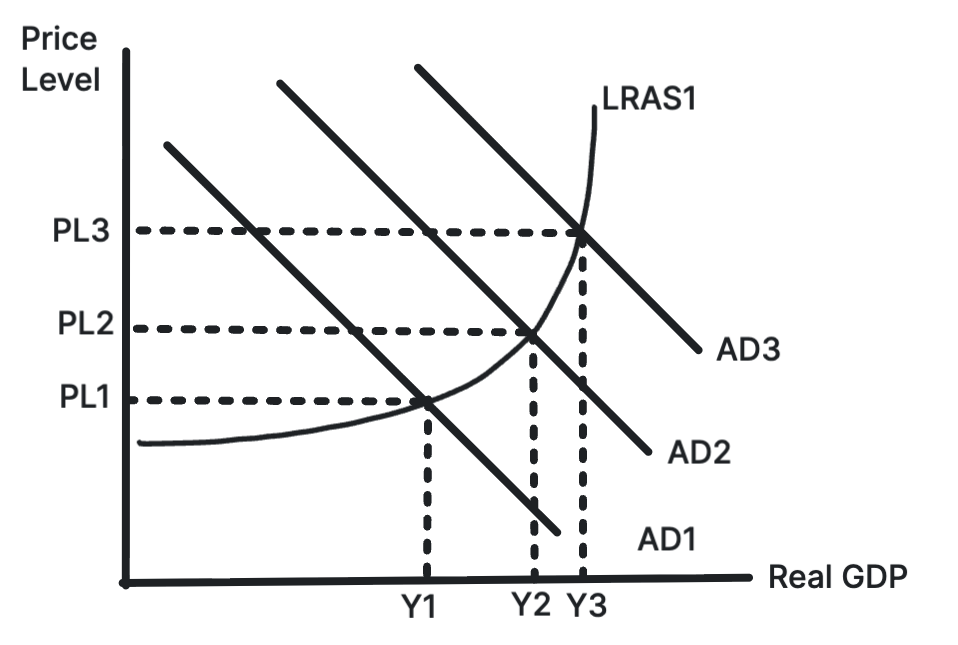
Factors Affecting the Size of the Multiplier
- Marginal Propensity to Consume (MPC): A higher MPC means a larger multiplier, as more income is spent rather than saved.
- Marginal Propensity to Withdraw (MPW): A higher MPW (through saving, taxation, or imports) reduces the size of the multiplier. Therefore interest rates and taxation rates can impact the multiplier.
- Economic Conditions: In a recession, the multiplier may be larger due to higher spare capacity and lower interest rates, which encourage spending.
- Confidence: If households and firms are confident about the future, they are more likely to spend, increasing the multiplier effect.
Stuck on this topic? Work through it with an online A-Level Economics tutor in a free 15-minute intro call, or send an essay on it for A-Level Economics essay marking.