Injections and Withdrawals
Recap: The Extended Circular Flow
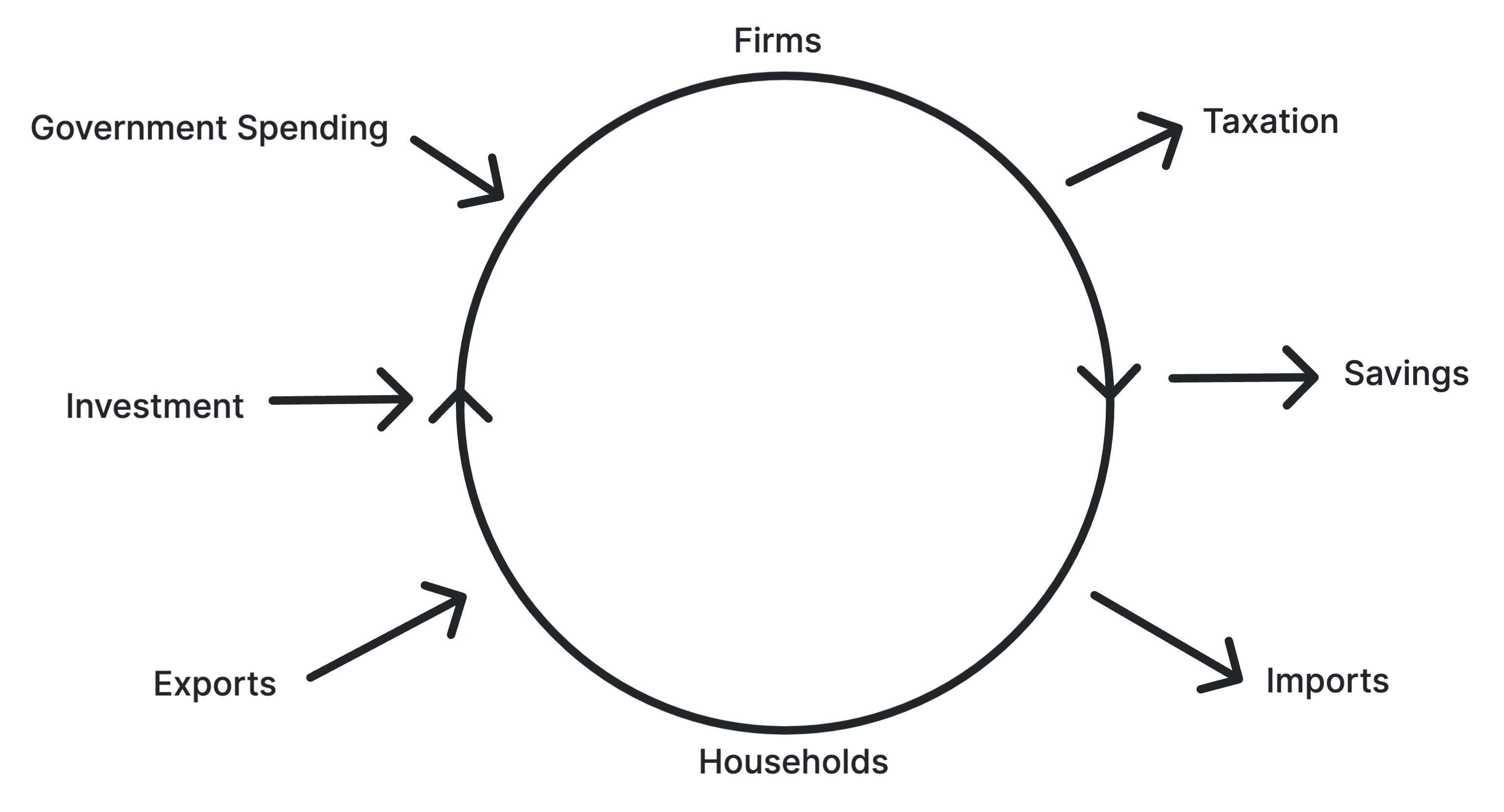
The circular flow model can be expanded to include the government, the financial sector, and foreign trade.
This creates flows of money that can either increase or decrease the size of the national income flow.
Injections (J)
Injection: Income from outside of the closed economy that enters the circular flow of income (Government Spending, Investment, and Exports).
Injections are additions of new spending into the circular flow. They increase aggregate demand and expand the size of the economy.
- Investment (I): Spending by firms on capital goods such as new machinery and factories. The source is the financial sector.
- Government Spending (G): Spending by the public sector on state-provided goods and services such as the NHS, roads, and education.
- Exports (X): Revenue from foreign buyers purchasing domestically produced goods and services.
Withdrawals or Leakages (W)
Withdrawal: Income that leaves the circular flow of income and is not passed on as spending (Savings, Taxation, and Imports).
Withdrawals are incomes not spent on domestic output, so they reduce the size of the circular flow.
- Savings (S): Household income not spent but placed in banks or pensions. The destination is the financial sector.
- Taxation (T): Income paid to the government, such as income tax or VAT.
- Imports (M): Spending on goods and services produced abroad. The destination is overseas.
Equilibrium and Economic Change
- National income is in equilibrium when total injections equal total withdrawals.
\[ J = W \]
\[ I + G + X = S + T + M \]
- If injections are greater than withdrawals, the circular flow expands and the economy grows/national income increases.
- If withdrawals are greater than injections, the circular flow contracts and the economy moves towards decline or recession/national income decreases.
The Multiplier Effect
The multiplier means that an initial change in injection, such as a rise in government spending or investment, creates a larger final increase in national income.
The original injection becomes someone else's income. That person then spends a proportion of it, based on their marginal propensity to consume (MPC), which becomes income for others, and so on.
As a result, the total rise in national income is a multiple of the initial injection.
This is covered in greater detail in 4.2.3 The Multiplier.
Stuck on this topic? Work through it with an online A-Level Economics tutor in a free 15-minute intro call, or send an essay on it for A-Level Economics essay marking.