National Income
The Circular Flow of Income
This model shows how money and resources flow between households and firms in a simple economy. It illustrates the interdependence of these two main economic agents and how they interact in the production and consumption of goods and services.
The Basic Model
In a closed economy with no government, there are two main agents: households and firms.
Real Flows: Households provide factors of production, including land, labour, capital, and enterprise, to firms. Firms provide goods and services to households.
Money Flows: Firms pay income in the form of rent, wages, interest, and profit to households. Households then spend this income as consumer expenditure on goods and services, which becomes revenue for firms.
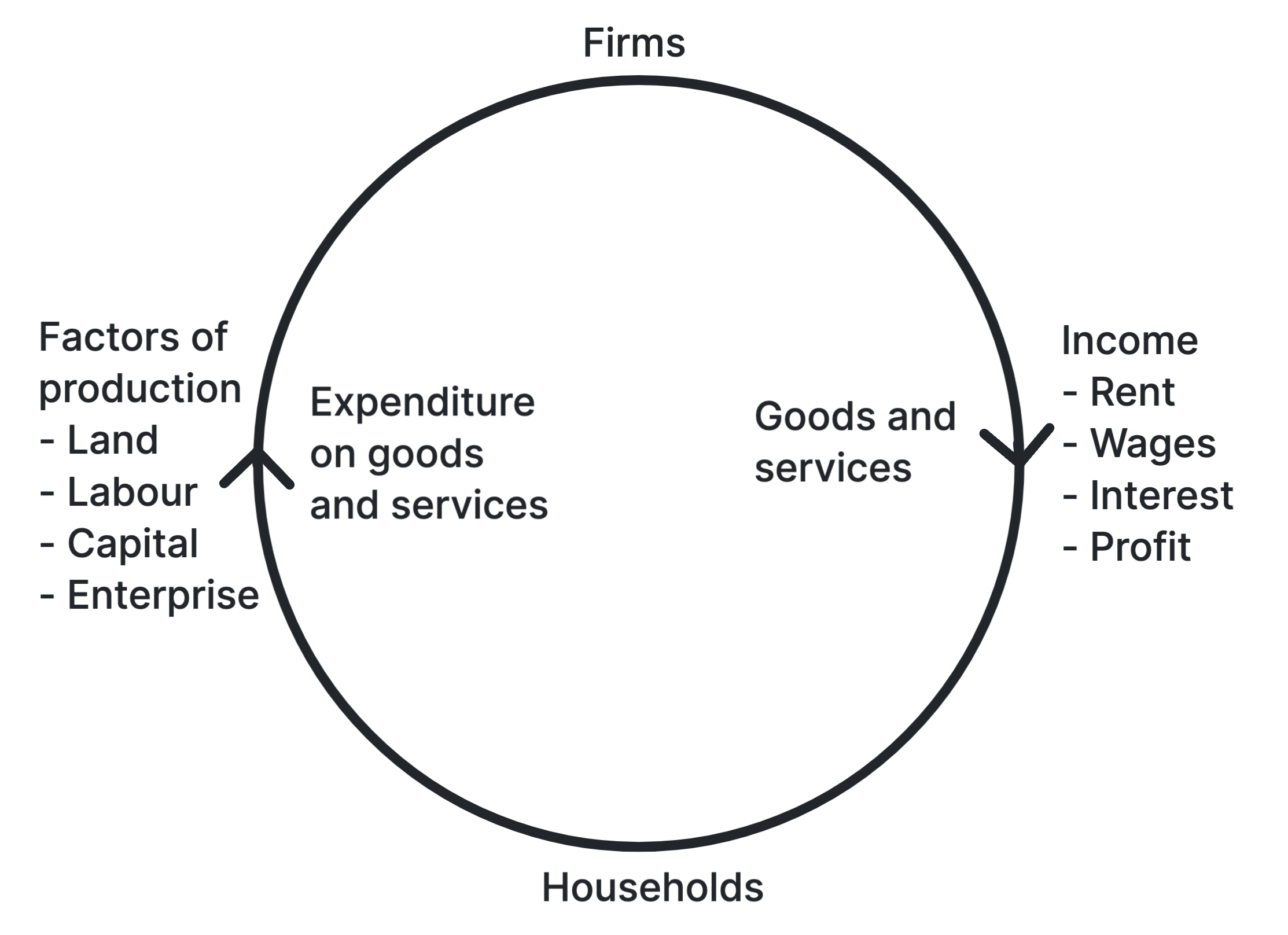
Injections and Withdrawals
The basic circular flow model can be expanded to include the government, the financial sector, and foreign trade. This introduces flows that change the size of the circular flow.
Injections
Injections (J): Additions of new money into the circular flow.
- Investment (I): Spending by firms on capital goods.
- Government Spending (G): Spending by the state on public goods and services.
- Exports (X): Revenue from overseas buyers purchasing domestic goods.
Withdrawals or Leakages
Withdrawals (W): Money leaving the circular flow.
- Savings (S): Household income that is not spent.
- Taxation (T): Money paid to the government.
- Imports (M): Money spent on goods from abroad.
Equilibrium in the Circular Flow
- National income is in equilibrium when total injections equal total withdrawals.
\[ J = W \]
\[ I + G + X = S + T + M \]
- If injections are greater than withdrawals, the circular flow expands and the economy grows.
- If withdrawals are greater than injections, the circular flow contracts and the economy moves towards decline or recession.
National Income: Key Concepts
National Income: The total value of output, expenditure, and income generated in an economy over a period of time, usually a year.
There are three ways of measuring national income, and in theory they should all give the same total.
Output Method: The value of all goods and services produced.
Income Method: The sum of all incomes earned, including wages, rent, interest, and profit.
Expenditure Method: The sum of all spending, using the expression \( AD = C + I + G + (X - M) \).
Income vs. Wealth:
- Income: A flow of money received over a period of time, such as wages or interest.
- Wealth: A stock of assets that can generate income, such as property or savings.
Stuck on this topic? Work through it with an online A-Level Economics tutor in a free 15-minute intro call, or send an essay on it for A-Level Economics essay marking.