Long-Run Aggregate Supply
What Is LRAS?
Definition: Long-run aggregate supply is the total potential output of an economy when all factors of production are fully and efficiently employed.
It represents the economy's productive capacity.
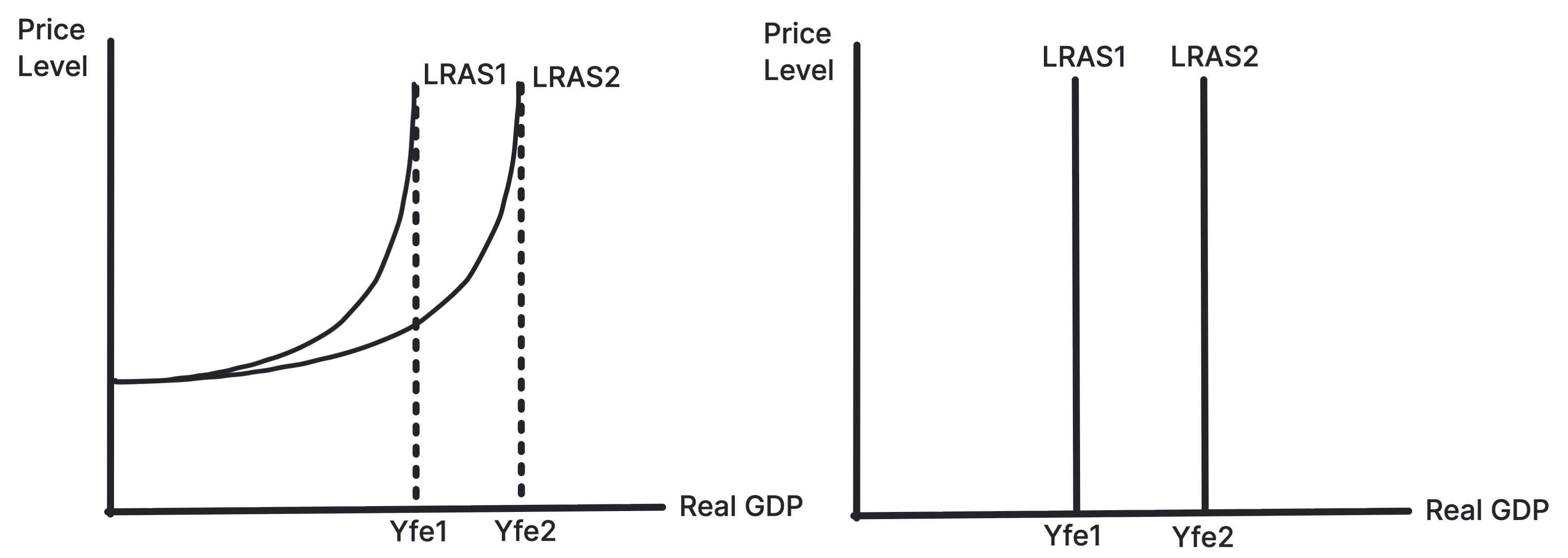
Key Idea: Shifts in LRAS represent long-run economic growth or decline, which is equivalent to an outward or inward shift of the production possibility frontier.
Two Views of the LRAS Curve
Economists disagree about the shape of the LRAS curve, leading to two main models.
The Classical View
Belief: In the long run, the economy will always adjust to full employment, so the level of output is determined by the quantity and quality of the factors of production, not by the price level.
The Curve: LRAS is perfectly inelastic, so it is vertical at the level of output corresponding to full employment, Yfe.
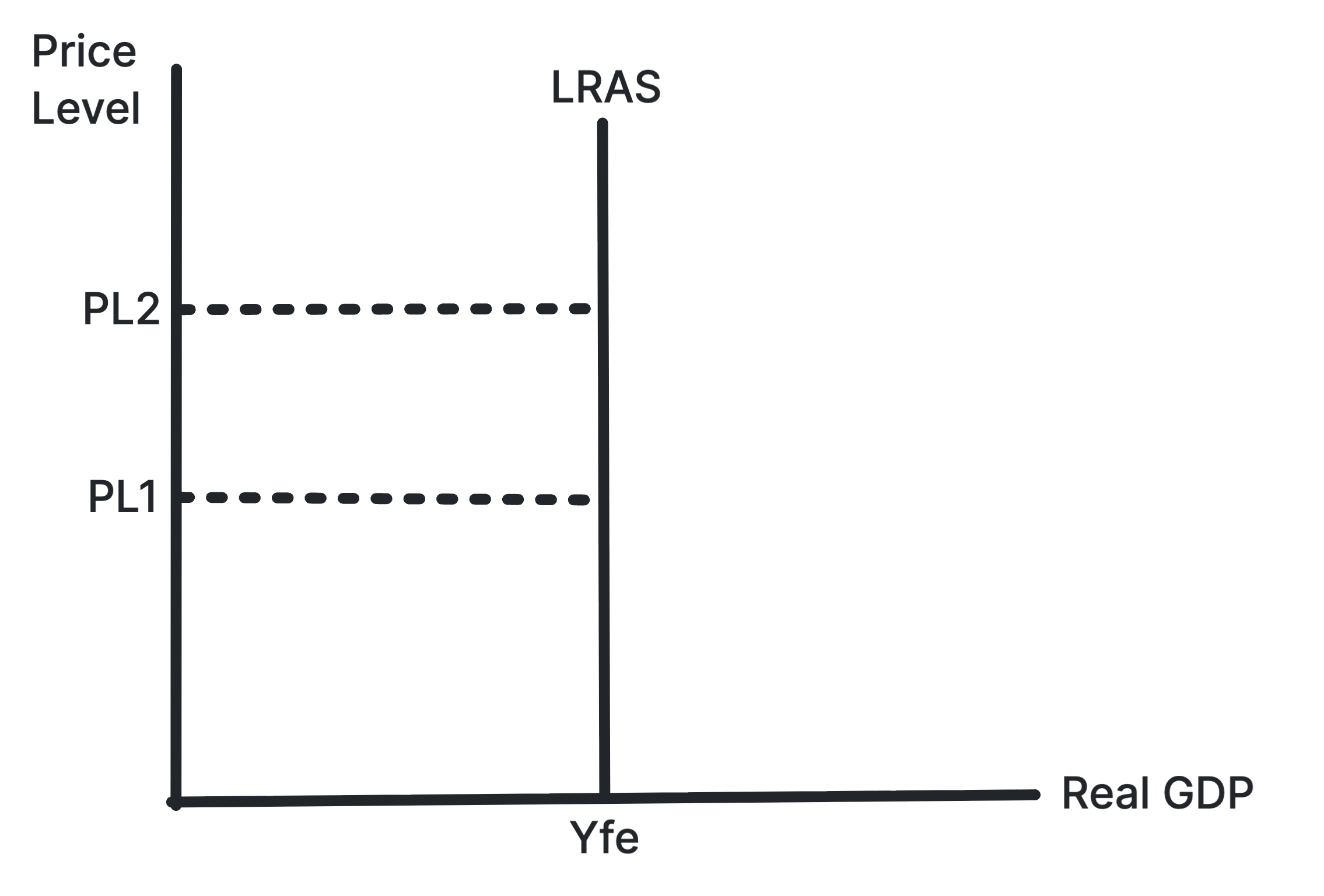
Analysis: In this view, any change in aggregate demand changes only the price level in the long run, not the level of real output.
The Keynesian View
Belief: The economy can be below full employment for a long time, so the level of output can be influenced by aggregate demand in the long run, especially when there is spare capacity.
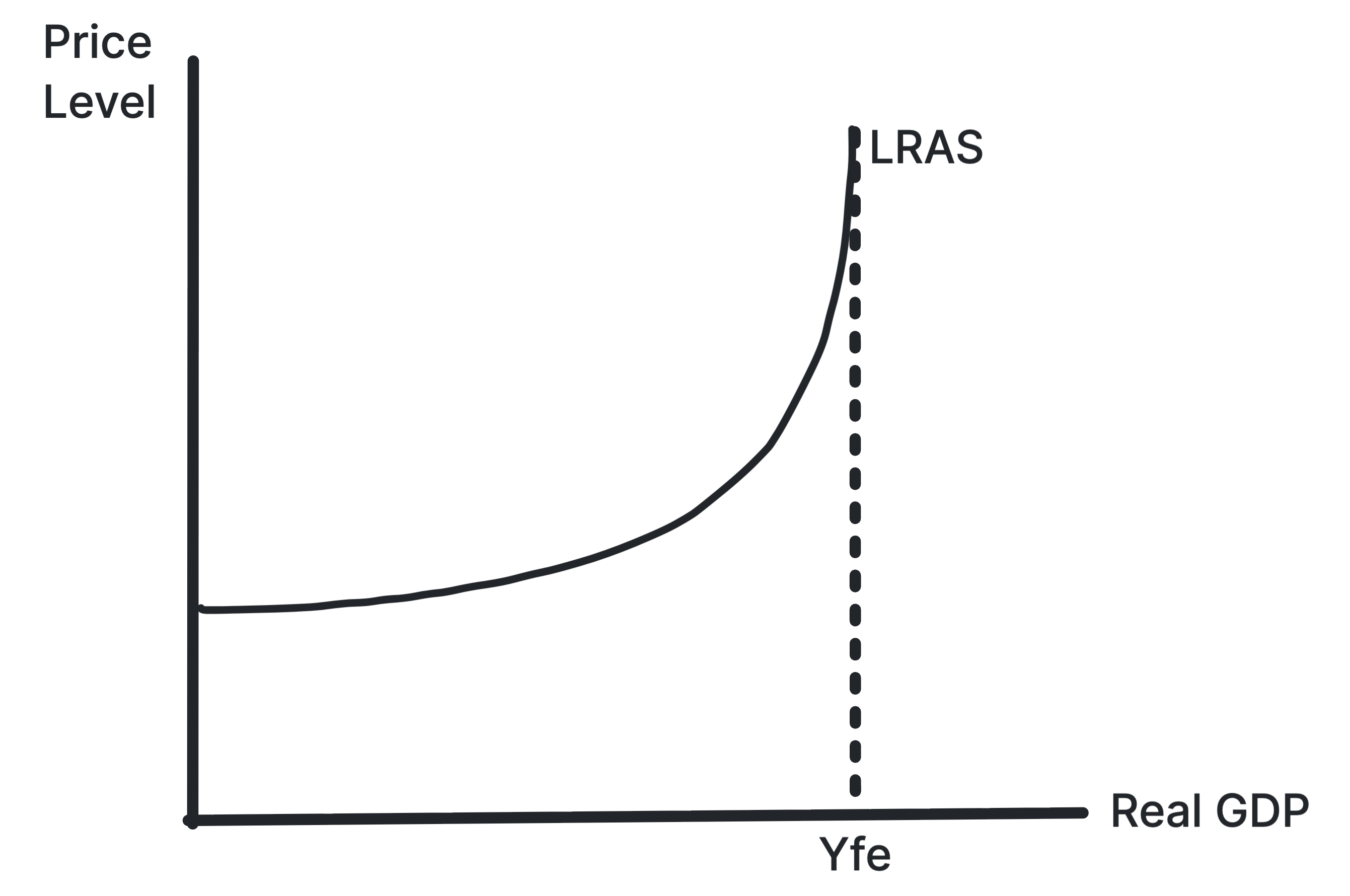
The Curve: LRAS is non-linear and often shown as L-shaped.
- It is perfectly elastic at low output where there is large spare capacity. This is because firms can increase output without increasing costs or prices due to the availability of unemployed resources.
- It becomes upward sloping as the economy approaches capacity and inflationary pressures build. This is because resources have become scarcer, so firms face rising costs to employ the remaining resources and pass these on to consumers in the form of higher prices.
- It becomes vertical at full capacity output, Yfe. This is because all resources are fully employed, so any further increase in aggregate demand will only lead to higher prices, not higher output.
Factors Influencing LRAS
Any change in the quantity or quality of the factors of production, including land, labour, capital, and enterprise, will shift LRAS and change the economy's productive potential.
| Factor | Effect on LRAS | Example |
|---|---|---|
| Technological Advances | Improve the quality of capital and make production more efficient. | AI, automation, and new manufacturing techniques. |
| Changes in Education and Skills | Improve the quality of labour and create a more productive workforce. | Greater spending on training and higher education. |
| Changes in Productivity | Increase output per worker or per hour, allowing more to be produced from the same inputs. | Better management and improved production processes. |
| Demographic Changes and Migration | Increase the quantity of labour and expand the working-age population. | Positive net migration or a rising birth rate. |
| Increase in Capital Stock | Increase the quantity of capital, such as machinery and infrastructure. | High levels of investment by firms and government. |
| Competition Policy and Deregulation | Improve efficiency and encourage enterprise and innovation. | Breaking up monopolies and reducing barriers to entry. |
| Institutional Improvements | Improve the quality of institutions and encourage investment. | Stronger property rights and lower corruption. |
The policies that governments use to shift LRAS are called supply-side policies. These are covered in detail in 2.6.3 Supply-Side Policies.
Stuck on this topic? Work through it with an online A-Level Economics tutor in a free 15-minute intro call, or send an essay on it for A-Level Economics essay marking.